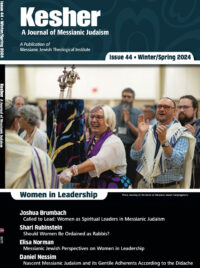
From the Editor – Issue 44
By Russ Resnik
One of the liveliest ongoing discussions in the Messianic Jewish world concerns the ordination of women as rabbis. Kesher has helped advance this discussion, most recently in our last issue (Kesher 43) with Paul Saal’s article “No Longer Male or Female? A Case for Leadership Equality for Women in the Messianic Jewish Synagogue.” In this…
Called to Lead: Women as Spiritual Leaders in Messianic Judaism
By Joshua Brumbach
The question of women serving in spiritual leadership is still quite controversial. To complicate matters, the debate often depends on the particular role(s) under discussion. Obviously, a woman serving in children’s education is far less controversial than a woman serving as an elder or ordained clergy. Furthermore, all sides argue their respective position is the…
Should Women Be Ordained as Rabbis?
By Shari Rubinstein
Should women be ordained as rabbis? Many learned men and women have been weighing in on this question, especially within Messianic Judaism, over the last several decades. Some of the most in-depth treatments of this issue from both the egalitarian and complementarian perspectives have been offered in the last few years. This article aspires to…
Messianic Jewish Perspectives on Women in Leadership
By Elisa Norman
This article will map Messianic Jewish perspectives regarding women in ministry leadership along a complementarian-egalitarian continuum. I will explore four main themes along the continuum: 1) male headship is a picture of the gospel, 2) the “harmony of the sexes”1 illustrates complementarity with egalitarian leanings, 3) ordination is possible within a pioneering movement, and 4)…
Nascent Messianic Judaism and its Gentile Adherents According to the Didache
By Daniel Nessim
Introduction Over two centuries ago, “a group of forty-one Jewish Christians met together in Jews’ Chapel in Spitalfields, London, to constitute themselves an association called ‘Bnei Avraham’ (Sons of Abraham).”1 As they met, the French Revolution was a recent memory and Napoleon Bonaparte was the emperor of France. Napoleon had conquered much of continental Europe…
The Siddur in The Formation of Messianic Jewish Identity and Communal Boundaries
By Karen Cheng
The Siddur is a treasure trove of narratives for worship. The prescribed structures and words in the traditional prayers guide observant Jews to transmit faith and tradition from generation to generation.1 When thousands of Jews encountered Yeshua as the Messiah in the 1970s, Messianic Jewish congregations emerged to contextually express “a Jewish life renewed in…
A Prophetic Friendship: Abraham Joshua Heschel and Martin Luther King Jr.
By Ben Volman
From January 1963 until his death in April 1968, Martin Luther King Jr. enjoyed a heartfelt, mutually encouraging friendship with Abraham Joshua Heschel while each became more closely aligned with the other’s political and social activism. This paper examines their spiritual origins, their individual development into national and international prominence, the religious context in which…
Book Review
The Gospel of Mark: A Beginner’s Guide to the Good News, by Amy-Jill Levine
By Russ Resnik
Review by Russ Resnik Amy-Jill (“AJ”) Levine is a prominent scholar and academic, Professor of New Testament Studies Emerita at Vanderbilt University, the first Jew to teach New Testament at Rome’s Pontifical Biblical Institute, and coeditor of the Jewish Annotated New Testament. In recent years, she has produced a number of popular and accessible studies in…