
Awakening the Inner Voice: Prayer, Identity and Divine Encounter
In the most desperate times people turn to one of the greatest gifts: communication with the Creator through prayer. In these moments of trial and testing, prayer emerges and our spiritual voice finds its identity.
What is prayer? The ever elusive, conclusive answer, which perhaps unlocks the door to the essence of what it means to be a finite and fragile human being in relationship with a transcendent and omnipotent deity, has been deemed by many devout practitioners to be worth the search.1
Many devout practitioners have sought to define prayer. Two prominent leaders from the 20th century are worthy to be studied: Jewish scholar and philosopher Abraham Joshua Heschel and Christian Monk Thomas Merton. In the crisis of the Holocaust, the Civil Rights, and many other social issues of their time, both Merton and Heschel sought to bring forth hope by defining the meaning of prayer. Just as a butterfly finds its identity from emerging from the darkness of the cocoon, so too, one finds identity through prayer in the darkness of life. It is at this moment that the voice of prayer arises and the individual transforms to bring forth the will of God.
This article argues that, for Heschel and Merton, prayer is essential for humankind to discover its identity through divine encounter with God. While Merton approaches this through contemplation and union with Jesus, and Heschel through covenantal responsiveness of good deeds and visibility before God, both affirm that prayer awakens the inner voice and empowers a life aligned with the will of God. By studying the definitions of prayer that Heschel and Merton offer through the themes of identity and divine encounter, this article seeks to answer the weighty question of “what is prayer?”
THOMAS MERTON
Solitude and Silence: Developing the Identity of the New Man
Thomas Merton’s view of prayer is a time of sitting before God in contemplation, in search of an encounter with God. Fearing God is necessary in such an attempt to connect with him. Merton described this fear, or reverence, as the “dread” of a believer. It is the idea that before God we are sinners; we are nothing, empty without him. This dread in monastic tradition is treated as the “fear of the Lord,” which is the beginning of wisdom.2 Out of this dread, a person should not be led to despair but rather to self-discovery through an encounter with God though prayer. For Merton, dread lies at the foundation of contemplative prayer which is the next step in a life of prayer. When discussing contemplative prayer, Merton advances meditation, solitude, and purity of heart. These three aspects are rooted in the idea of personal prayer. In personal prayer these are necessary to release spiritual disciplines in the believer’s life; for example, fasting, teaching, counseling, and service.3 Absent personal prayer, these disciplines are not generated during the time expended in prayer, and thus lose their effectiveness. Developing the practices of meditation, solitude, and purity of heart are critical for recognizing Merton’s thoughts on how personal prayer drives action in the life of a believer.
“All good meditative prayer is a conversion of our entire self to God.”4 While meditation requires discipline and is traditionally viewed as prayer of the mind,5 it is much more than a technique used to find oneself or connect with God. It is not just a formula of words or a series of desires springing up from the heart. Rather, it is the orientation of our whole body, mind and spirit toward God in silence, attention, and adoration.6 As much as prayer is connecting with God, it is also about the inner transformation that happens within the individual. In Romans 12:2, Paul discusses this transformation when he says, “Do not be conformed to this world, but be transformed by the renewing of your mind.”7 In Hebraic thought, of which Paul was familiar, heart and mind are synonyms. Ultimately, this transformation happens as a result of the Holy Spirit working within the life of the believer, during the time of meditative prayer. When entering into meditative prayer, a person seeks to fully orient on God and allow the transformation to begin. The goal of this transformation is to be like Messiah. As Paul says, “we all, with unveiled face beholding as in a mirror the glory of the Lord, are being transformed into the same image from glory to glory — just as from the Lord, who is the spirit.” (2 Cor 3:18) However, Merton underscores a problem should the idea of the imitation of Messiah remain exterior. He maintains, “sometimes methods and programs of meditation are aimed simply at learning to play a religious role.”8 This is where the believer builds off the idea of having this dread of himself before God. Seeing oneself as nothing allows a complete focus on God, and thus, be filled with the Holy Spirit, as opposed to being self-filled. The true fear of the Lord happens when realizing how reliant we are on the Creator. Only when the process of this transformation begins, will a person come to realize “who I am” intended to be, which should be like Christ (Messiah). As Merton develops his thoughts on meditative prayer leading to transformation, Jesus’ statement in John 15 — “I am the vine and you are the branches” — comes into alignment with Merton’s thought on how this leads to action in the life of the believer. In John 15:1-8, Jesus describes how apart from him, his followers can do nothing. Merton concludes that the believer who becomes more like Messiah, will reach a point of detachment and freedom with regard to inordinate cares, doing without them for the sake of higher ends.9 The believer then may focus on the good things of life for the sake of the Kingdom of God.
The instruction to “Be still and know that I am God” is of great importance for solitude in the monastic way of life and its history (Psalm 46:10). Merton develops his thought of silence rooted in the dread of the believer by quoting St. Macarius:10 “It is not necessary to use many words. Only stretch out your arms and say: Lord have pity on me as you desire and as you well know how!”11 Merton calls this time of silence “interior recollection.”12 It is the idea of keeping Messiah Jesus continually on one’s mind. Merton’s description of sitting in silence is awesome; the basic idea is developing the life of Messiah within us. For believers, Jesus is the way of knowing God, which is why Psalm 46:10 is a staple in monasticism. The result of focusing on Messiah is a pouring out of the Holy Spirit. In this time of interior recollection the reading of scripture, specifically the Psalms, is the way to focus on Messiah and develop the interior life. Time of silence is not just strictly linked with monastic isolation, but rather a solitary life is a continual awareness of a person’s poverty and needs before God.13 Merton is fully aware that the monastic way of life is applicable for any vocation a believer chooses. Solitude and silence then are not limited to monks, even if it is more part of their spiritual practice than others. The solitary life is prayer immersion and this is applicable to anyone who chooses to pray. For Merton, his belief is that silence and prayer form a continual loop where one’s whole life becomes a prayer because all the silence is full of prayer.14 With Jesus always on one’s mind, Merton invokes John 5:19-20 to demonstrate how silence leads to action:
The Son cannot do anything by himself. He can do only what he sees the Father doing. Whatever the Father does, the Son does likewise. For the Father loves the Son and shows Him everything He does. (John 5:19-20)
Silence then is not just isolation or “quiet” time, but rather an understanding of neediness and dependence on God through Messiah Jesus, which is manifested through the Holy Spirit. Keeping this ever present in mind results in a life that is all prayer. Merton maintains that we pray in order for God to hear and answer us.15 However, the answer we receive must be God’s answer so that we know what the Father is directing us to do.
As Merton develops the idea of contemplative prayer through meditation and silence, the end result is purity of heart. The initial step is “prayer of the heart,” in which one seeks first the deepest ground of identity in God.16 As we build upon meditation and solitude — the process of focusing on Messiah, and the work of the Holy Spirit — we come to the place of finding identity in God. All prayer, reading, meditation, and other activities of the monastic life are aimed at purity of heart. Purity of heart is the enlightened awareness of the new man.17 This leads us to a fuller understanding of who we are and the world in which we live. For then we are actually now living as the created beings that God made us to be. It is actually a bad virtue if prayer leads someone to neglect the world around them and “escape” reality. A person cannot truly impact the world in absence of a knowledge of self-identity and God’s calling. When this occurs, the new man is awakened, and truly enlivened to live for God. As the reality of the crucifixion stake was present before Yeshua, his prayer in the garden was “not my will, but your will be done.” (Luke 22:42) This demonstrates that prayer then is not an escape from reality, but rather an opening to God’s will being done. This happens when one has purity of heart, as Merton has described.
ABRAHAM JOSHUA HESCHEL
The Living Soul: The Divine Encounter in the Depth of Prayer
Abraham Joshua Heschel viewed prayer as a way to seek God, be known by him, and live a life that sanctifies the world. While he shares similar views with Merton regarding prayer, he often arrived at slightly different conclusions. “Prayer is an event that starts in man and ends in God.”18 Heschel too believes that prayer is an encounter that shifts the focus away from the one praying, and directs attention to God. For Heschel, prayer is defined by God’s desire to know us and our deeds. To pray is to believe that God is actually present to listen, and respond. Jeremiah 33:3 is an example of the faith that is required: “Call to me, and I will answer you — I will tell you great and hidden things, which you do not know.” Heschel interprets this as God’s desire for us to pray and it is through prayer that God knows us. God looks down from heaven to see if anyone seeks him in prayer (Psalms 14:2). Why? Because in this seeking, the one who prays is exposed fully before the Lord. This is how David can say, “Adonai, You searched me and know me.” (Psalm 39:1) In his search for God, he allowed nothing to be hidden, even though God knows all. Thus, it is through prayer that a person is exposed to truly be known by God. Prayer then makes visible the things that are right and gives meaning to our deeds.19 Heschel’s beliefs on prayer are deeply rooted in God knowing us by our deeds.
Both Heschel and Merton recognize the inner transformation during prayer, as a gift from God. This transformation was of supreme import to Heschel as he sought to bring a deeper meaning of prayer to Jewish society and the synagogue. The habit of prayer is not the problem, but the lack of soul in prayer. Creating the habit of praying is important and necessary for developing a life of prayer, according to Heschel. Mere recitation of prayers without the heart engaged, lacks soul, which ultimately lacks life. As a result, this lack puts distance between us and God, which interferes with God’s longing for man where he consistently demonstrates his desire to draw near to us.20 Advancing Heschel’s thoughts on the idea of the soul being engaged in prayer (which gives life to prayer), there is additional meaning in the creation of man: “And the Lord God formed man out the dust of the ground and breathed into his nostrils the breath of life and man became a living soul.” (Gen 2:7) God breathing into man the breath of life was not just man coming to life but God affording man the ability to speak. God gives us breath of life so we may communicate with him.
Heschel writes much on the soul not engaged in prayer, hinting that God gave man a soul for the purpose of being in dialogue with him. Thus, from the beginning God desired for man to communicate with him. The next logical step may be found in the popular Jewish phrase: “know before whom you stand.”21 Heschel believes that it is impossible to pray without an understanding of God; living a prayerless life, is to live without God. Another similarity between Heschel and Merton is found in the idea of praying to know God.22 While Merton finds this fulfilled in Jesus, Heschel concludes that our knowing God is in reality God knowing us. This thought was fundamental to Heschel’s view of spirituality:
The Bible speaks not only of man’s search for God but also of God’s search for man. Thou dost hunt me like a lion, exclaimed Job (10:16). . . . This is the mysterious paradox of Biblical faith: God is pursuing man. It is as if God were unwilling to be alone, and He had chosen man to serve him. Our seeking Him is not only man’s but also his concern, and must not be considered an exclusively human affair.23
Continuing with the idea of God giving man a soul to communicate with him, one reads of Adam and Eve hiding from God. In Genesis 3:9 God calls out to man, “Where are you?” It is from this verse that Heschel concludes that God is in search of man and desires to know us. The problem Heschel sees regarding prayer is that the soul of man is dead and distant from God. The inner transformation of the soul occurs only when man begins to pray. However, it is not just the prayer that creates the change, but rather faith in the fact that God desires our communication. It is faith in knowing that God not only desires to hear from us; he desires to speak to us. When God speaks, a person is truly transformed and the beginning that started in man finds its end in God.
According to Heschel, “To pray is to bring God back into this world.”24 Should a lack of prayer lead to increased distance from God, then logically prayer brings God closer into this world and in the life of the one who is praying. This is the power of prayer. It is directly tied to God’s existence. “One who comes to God must believe that he exists.” (Hebrews 11:6) Faith in his existence generates a belief that he can be addressed. This allows us to see him and know that he is ever present. Through a lack of prayer, his realness becomes absent in our lives. However, it is not God’s existence that is at stake here; rather, it is man’s. As Heschel remarks, “it is not God who becomes visible through prayer, but rather we make ourselves visible before God.”25 While Merton would promote this process in contemplative prayer, Heschel believes it is through deeds. Man is not just a spiritual being; rather, he is flesh and soul, thus actions count. In addition to faith, Judaism places significance on good deeds, i.e., doing mitzvot. Man is created in God’s image (Gen 1:26); hence, great importance is placed on doing mitzvot because this allows man to bear the image of God. We can love and care for others because God first showed us how he loves and cares for us (1 John 4:19). There can be a tendency to place deeds over spirituality and vice versa. However, Heschel views both as equally important and values both working together in one’s life. Proverbs 4:23 clarifies that a person should guard their heart because everything one does flows from there. This places importance on the inner life as it will be manifested in actions. Our thoughts, feelings, and beliefs affect everything we do. Heschel believes that when a person prays, that person’s whole life enters the prayers.26 God gave humans a soul; when Adam and Eve disobeyed by their deeds; they became less visible before God. When our actions flow from our heart and are carried into the presence of God, then how can one have assurance they will be visible to God? As Proverbs answers, “My son, give me your heart, and let your eyes observe my ways” (Prov 23:2). God desires that all yield their heart to him and observe his ways. The goal is for God to be ever present in our heart, so that his ways flow out of our life, making us more visible to him. As one becomes more visible to God it allows him to be more visible to us, and thus more present in our world. For Heschel, this is the goal of prayer: to bring God back into this world and allow his kingship to reign.27
Conclusion
For Heschel, prayer was a way for man to not only know God, but God to know man. Prayer awakens the soul of humankind, bringing about one’s true identity. His thoughts addressed the problem he saw in his time. It was not that God was absent in the world, but that the lack of soul in prayer created a lack of God’s presence. Prayer had often become just another
“ritual” in the synagogue. In a time where many could ask, “Where is God?” Heschel’s response was, God is asking man, “Where are you?”
For Merton, prayer was a recognition of our need for Jesus through the concept of the “dread” of God — the awareness that all are sinners before God. He believed there was no greater calling than to sit in contemplation and meditate on the supremacy of Messiah. This leads to a divine encounter and awakening of the “new man” through the transformative power of the Holy Spirit. While not everyone is called to this vocation, principles of contemplative prayer, silence, solitude, and prayer of the heart, may still be applied to any lifestyle by a continual focus on Messiah in all parts of life.
Merton and Heschel imagine prayer as extremely important to awaken identity, and bring about inner transformation that then manifests in outward actions. Prayer should fuel everything one does. In every generation, especially in times of despair, Merton and Heschel’s teachings inspire us to develop a life of prayer which leads to discovering our identity through divine encounter — awakening the gift of the inner voice to communicate with the transcendent, omnipotent God.
With prayer deeply tied to one’s identity, Messianic Jews may apply the principles of both Heschel and Merton to understand what it means to be Jewish believers in Yeshua. While Merton emphasizes knowing God through contemplative recollection of the grace offered through Yeshua, Heschel emphasizes God knowing us through spirit-empowered deeds established through prayer. The words of Yeshua in Matthew 7:23 carry deep theological implications, emphasizing the connection between being known by God and the way we live: “Then I will declare to them, I never knew you. Get away from Me, you workers of lawlessness” (Matthew 7:23).
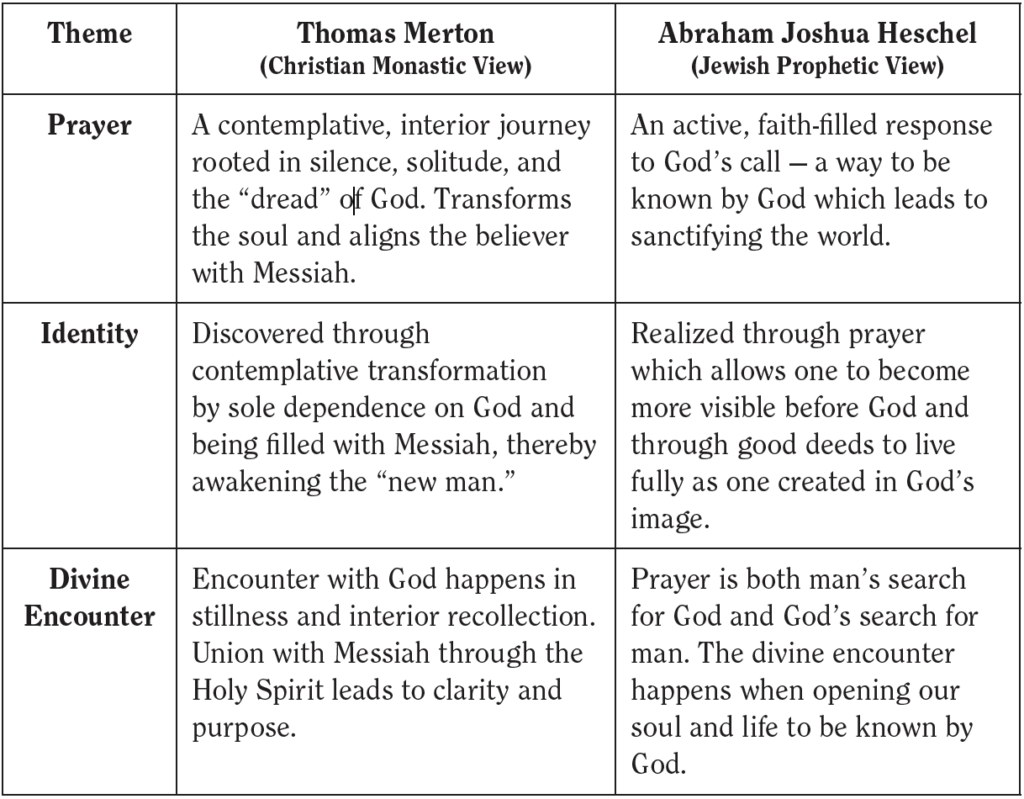
Both Merton and Heschel taught how deeds flow from the disciplines of prayer as a result of divine encounter. For Messianic Jews this is especially meaningful because as Jewish believers in Yeshua, their identity is found in the grace offered through Yeshua, while at the same time their identity is expressed in the outward deeds of a Torah observant life. Both Merton’s and Heschel’s views reinforce one another: as we encounter God, God encounters us — leading to a transformed life. The table (see the next page) offers more than just a comparison of Merton and Herschel; it illuminates how the disciplines of prayer shape one’s identity through God.
Table — How the disciplines of prayer shape one’s identity:
Tyler Hoose is a recent graduate of the Messianic Jewish Theological Institute, earning a Masters in Jewish Studies, with honors. He enjoys teaching and writing and runs a homeschool cooperative. Tyler recently established a site for others to enjoy his teachings at tylerhoose.carrd.co.
-
1 Glen, G. Scorgie, ed, Dictionary of Christian Spirituality, (Grand Rapids, MI: Zondervan, 2011), 166.
-
2 Thomas Merton, Contemplative Prayer (Crown, 2009), 84.
-
3 Merton, Contemplative Prayer, 52.
-
4 Thomas Merton, Thoughts in Solitude (Farrar, Straus and Giroux, 1999), 40.
-
5 In the monastic tradition, meditation was an integral aspect of the life of prayer. According to Jean Leclercq, it required the monk not only to think about the Scriptures, but “to practice a thing by thinking of it . . . to fix it in the memory to learn it.” Scorgie, Dictionary of Christian Spirituality, 607.
-
6 Merton, Thoughts in Solitude, 40.
-
7 All scriptures are from the Tree of Life Version (TLV) unless otherwise noted.
-
8 Merton, Contemplative Prayer, 47.
-
9 Merton, Contemplative Prayer, 51.
-
10 St. Macarius was a desert father which is a Christian order of Trappists. Trappists is the customary name of the Order of Cistercians of the Strict Observance, the most radical cloistered order in Roman Catholic monasticism. Scorgie, Dictionary of Christian Spirituality, 808.
-
11 Merton, Contemplative Prayer, xxviii.
-
12 Merton, Contemplative Prayer, x.
-
13 Merton, Thoughts in Solitude, 105.
-
14 Merton, Thoughts in Solitude, 91.
-
15 Merton, Thoughts in Solitude, 104.
-
16 Merton, Contemplative Prayer, 44.
-
17 Merton, Contemplative Prayer, 46.
-
18 Abraham Joshua Heschel, Quest for God: Studies in Prayer and Symbolism (Crossroad, 1982), 14.
-
19 Heschel, Quest for God, 8.
-
20 “For what great nation is there that has a god so near to it as the Lord our God is to us, whenever we call upon him?” Deuteronomy 4:7; “The Lord is near to all who call on him, to all who call on him in truth.” Psalm 145:18; “You will seek me and find me, when you seek me with all your heart.” Jeremiah 29:13.
-
21 b. Berachot 28b.
-
22 Abraham Joshua Heschel and Susannah Heschel, Moral Grandeur and Spiritual Audacity: Essays (Farrar, Straus and Giroux, 2001), 109.
-
23 Abraham Joshua Heschel, God in Search of Man: A Philosophy of Judaism (Farrar, Straus and Giroux, 1983), 136.
-
24 Heschel, Moral Grandeur and Spiritual Audacity, 110.
-
25 Heschel, Quest for God, 5.
-
26 Heschel, God in Search of Man, 302.
-
27 Heschel lived and taught with the idea of living now for the world to come. The world to come is based on the verse in Isaiah 2:2-4, when the Messiah of Israel will rule from Jerusalem and the nations will gather before the mountain of the Lord.